Sleep Architecture: How Omega Reimagines Deep Recovery Through Ambient Brainwave Entrainment
The next frontier in performance optimization is not another productivity tool — it is the deliberate engineering of sleep itself.
The Performance Ceiling You Cannot Train Past
Executive culture has spent decades optimizing waking hours. Morning routines, time-blocking frameworks, nootropic stacks, meditation protocols — all of them target the roughly sixteen hours a day we spend conscious. Yet the remaining eight hours, the period during which the brain consolidates memory, repairs tissue, regulates hormones, and resets emotional resilience, has been left almost entirely to chance.
That is a strategic oversight, not a minor one. Sleep is not the absence of productivity; it is the substrate on which every waking capability depends. When sleep architecture degrades — when the proportions of light, deep, and REM sleep shift out of alignment — cognitive throughput, decision quality, and physiological recovery decline in lockstep, often without the sleeper being aware of the erosion.
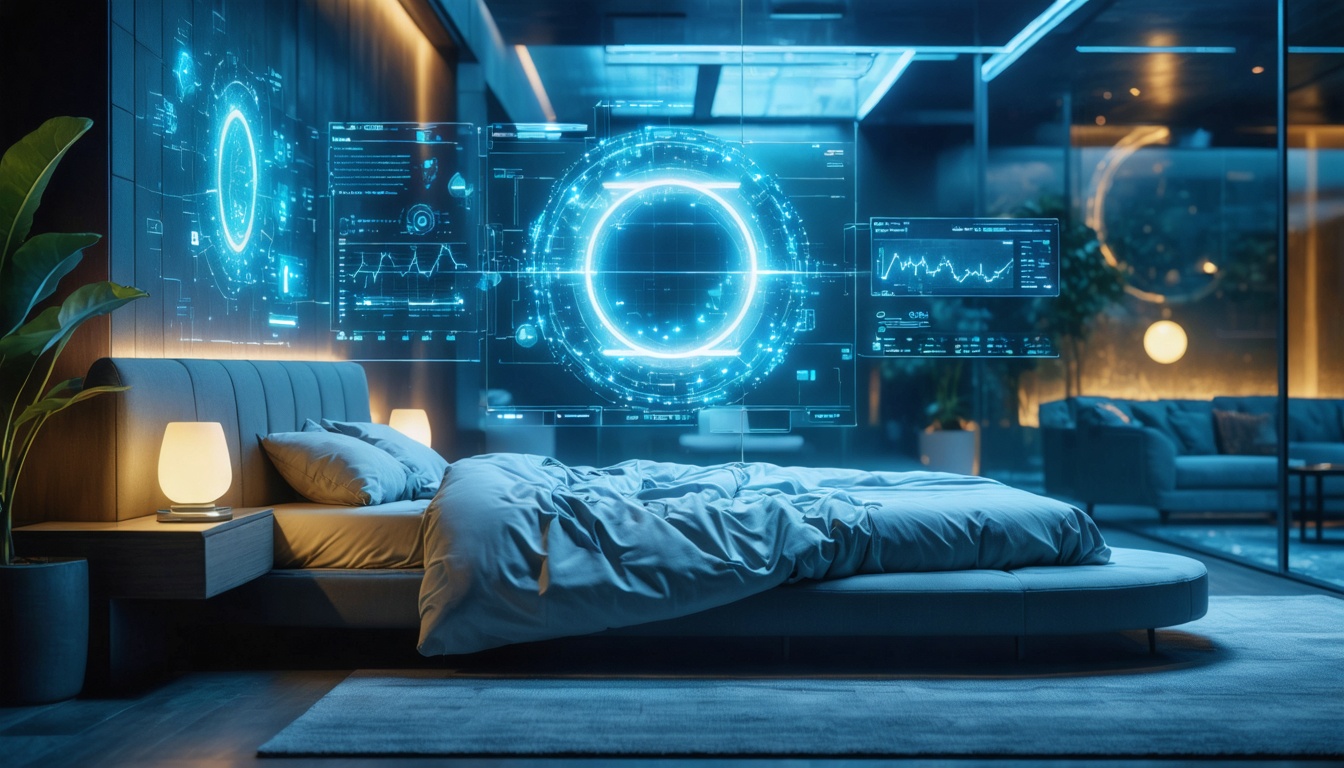
Omega is built on the premise that deep recovery should not be left to chance. By introducing automated, ambient brainwave entrainment into the sleep environment, Omega moves sleep from a passive biological event to an actively designed recovery protocol.
What Sleep Architecture Actually Means
Sleep architecture refers to the cyclical structure of sleep stages across a given night. A healthy adult typically cycles through light sleep (stages N1 and N2), deep slow-wave sleep (N3), and rapid eye movement (REM) sleep in roughly ninety-minute intervals. Each stage serves distinct physiological and neurological functions: slow-wave sleep drives tissue repair and growth-hormone release, while REM sleep supports memory consolidation and emotional regulation.
The problem is that modern life systematically undermines this architecture. Blue light exposure, irregular schedules, ambient noise, stress-mediated cortisol, and even altitude all distort stage proportions and transition timing. The result is structurally impaired sleep that may register as adequate on a clock but delivers a fraction of the restorative value the brain and body require.
Most consumer sleep solutions address surface-level symptoms — blocking light, masking noise, tracking metrics after the fact. They observe sleep architecture without intervening in it. Omega takes a fundamentally different approach: it acts on the architecture itself, in real time.
Brainwave Entrainment: The Mechanism Behind the Design
Brainwave entrainment is the well-documented phenomenon in which external rhythmic stimuli — auditory, visual, or tactile — influence the frequency of neural oscillations. When a periodic stimulus is presented at a frequency matching a target brain state, endogenous neural rhythms tend to synchronize with that frequency. This is not speculative neuroscience; the underlying principle, known as frequency-following response, has been studied in clinical and laboratory settings for decades.
Omega leverages this principle in an ambient, automated fashion. Rather than requiring manual configuration or wearable devices that introduce discomfort, Omega delivers precisely calibrated auditory and environmental cues designed to guide the brain toward the neural frequencies associated with deep slow-wave sleep. The system adapts continuously, modulating its output to support natural stage transitions rather than locking the brain into a single frequency band.
The distinction matters. Crude entrainment tools flood the environment with a fixed binaural beat and hope for the best. Omega treats the sleep cycle as a dynamic system and responds accordingly, reinforcing the biological rhythms the brain is already attempting to execute.
Why 'Ambient' and 'Automated' Are Not Marketing Language
Two design principles anchor Omega's approach, and both are worth examining in detail. The first is ambience. Effective brainwave entrainment during sleep must be non-intrusive. If the stimulus pulls the sleeper toward wakefulness — through volume spikes, uncomfortable wearables, or perceptible artificiality — it defeats its own purpose. Omega embeds its entrainment signals within an ambient soundscape that feels natural and recedes from conscious perception, allowing the stimulus to operate at the sub-threshold level where neural entrainment is most effective.
The second principle is automation. Sleep is, by definition, a state in which the user cannot actively manage a tool. Any system that requires conscious adjustment mid-cycle is architecturally flawed. Omega operates autonomously across the entire sleep period, managing its own calibration, stage-appropriate frequency targeting, and environmental responsiveness without requiring user intervention at any point after initiation.
Together, these principles reflect a design philosophy rooted in how sleep actually works rather than how technology companies wish it worked. The goal is invisible, continuous support — not another device demanding attention.
Deep Recovery as a Strategic Asset
For executives and high-performance professionals, the implications of reliably improved deep sleep extend well beyond feeling rested. Slow-wave sleep is the primary window for human growth hormone secretion, which drives physical repair and metabolic regulation. It is also the stage most closely associated with declarative memory consolidation — the ability to retain and recall factual information, strategic frameworks, and complex plans.
Chronic slow-wave sleep deficits have been linked in published research to impaired glucose metabolism, increased inflammatory markers, diminished executive function, and accelerated biological aging. These are not abstract health metrics; they are direct inputs to decision-making capacity, leadership endurance, and long-term career sustainability.
Omega reframes sleep optimization as a strategic investment rather than a lifestyle indulgence. When deep recovery is consistently and reliably achieved, the compound returns — in cognitive sharpness, emotional regulation, and physiological resilience — accrue night after night in ways that no waking-hour intervention can replicate.
Beyond Tracking: The Shift From Observation to Intervention
The consumer sleep technology market has been dominated by tracking devices for over a decade. Wristbands, rings, mattress sensors, and bedside monitors have become sophisticated at measuring sleep stages, heart rate variability, respiratory rate, and movement. This data is valuable, but it is fundamentally retrospective. It tells you what happened; it does not change what happens.
Omega represents a category shift from passive observation to active intervention. The system does not simply record your sleep architecture — it participates in shaping it. This is an important conceptual leap: the difference between a dashboard that reports declining revenue and a system that autonomously adjusts pricing and allocation to reverse the trend.
For organizations and individuals who have already instrumented their sleep environment with tracking technology, Omega is the logical next step. Data without action is overhead. Omega closes the loop.
Implementation Without Disruption
One of the most common failure modes in health technology is the demand for behavioral change. Products that require rigid adherence to new routines, physical discomfort from novel hardware, or significant reconfiguration of the sleep environment create friction that erodes adoption over weeks.
Omega is designed to integrate into existing sleep environments with minimal disruption. Its ambient delivery model means it does not require strapping on a headband, inserting earpieces, or rearranging furniture. Its automated operation means there is no nightly ritual to remember, no app to configure at 11 PM when willpower is depleted, and no data to interpret before the system delivers value.
This is not accidental simplicity — it is engineered restraint. The most powerful sleep intervention is the one that actually gets used, every single night, without fail. Omega is built for that standard of consistency.
The Road Ahead for Engineered Recovery
Sleep science is advancing rapidly, and the gap between what researchers understand about sleep's role in human performance and what consumer technology actually delivers is still vast. Omega occupies a forward position in that gap, applying well-established neuroscience principles through a system architecture designed for real-world reliability and real-world lives.
As the broader market matures, we expect the conversation to shift decisively from sleep tracking to sleep engineering — from knowing your sleep score to actively shaping the neural and physiological processes that determine it. Omega is built for that future, and for the professionals who refuse to leave their most critical recovery window to chance.
Key Takeaways
- •Sleep architecture — the cyclical structure of deep, light, and REM stages — is the foundation of cognitive and physiological recovery, and modern life systematically undermines it.
- •Omega uses automated, ambient brainwave entrainment to actively guide the brain toward the neural frequencies associated with deep slow-wave sleep, moving beyond passive tracking to real-time intervention.
- •The system operates autonomously and non-intrusively, requiring no wearables, manual adjustment, or nightly configuration — designed for consistent, frictionless adoption.
- •Reliably improved deep recovery compounds over time into measurable gains in executive function, emotional regulation, metabolic health, and long-term performance sustainability.
- •Omega represents a category shift from sleep observation to sleep engineering — closing the loop between data and outcome in the most consequential recovery window of the human day.